
When it comes to building safety, fire rated glass doors are more than just a design choice. They are a critical part of protecting lives and property. Although, there’s one feature that often goes unnoticed, even though it plays a vital role in how these doors function: the self-closing mechanism. Without it, the performance of a fire rated door can be compromised.
It may seem like a small detail, but in the middle of an emergency, it’s often the smallest details that make the biggest difference. Understanding the role of self-closing mechanisms in fire rated glass door safety is key if you want to design or manage a building that’s not only code-compliant but genuinely safe for everyone inside.
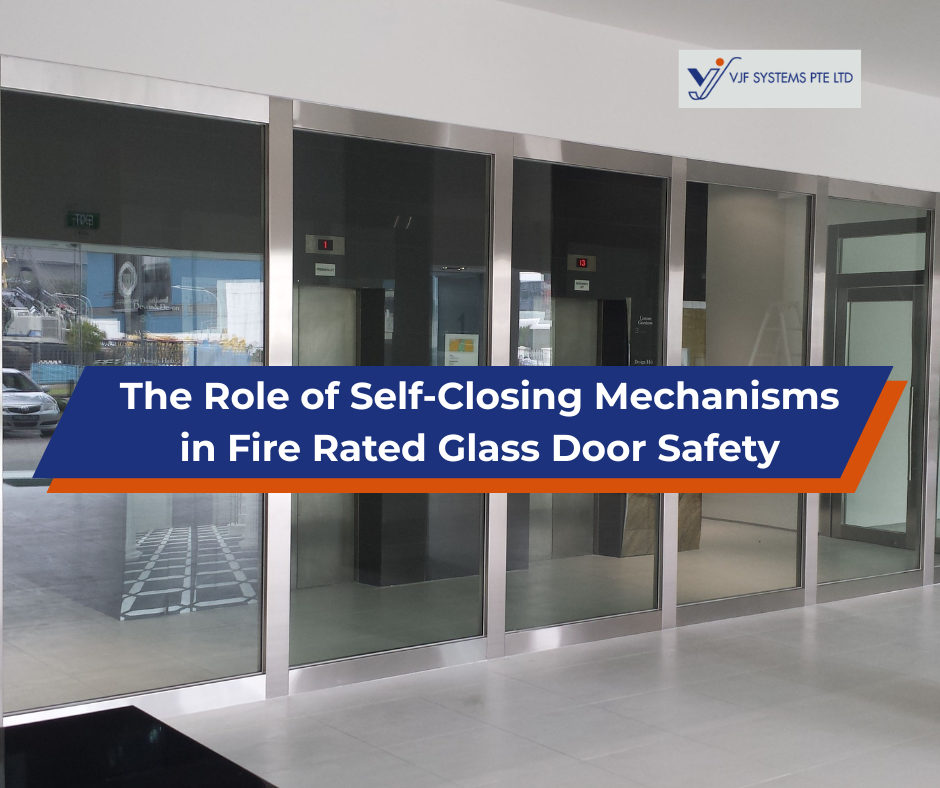
Why fire rated glass doors depend on self-closing mechanisms
Fire rated glass doors are engineered to resist fire and smoke for a set period, buying precious time during an emergency. But here’s the catch: they only do their job if they’re actually closed.
Without a self-closing mechanism, there’s no guarantee the door will shut at the exact moment it’s needed most. A door left open—even just a crack—can quickly turn into a pathway for fire and smoke. That single vulnerability can undermine the entire purpose of having a fire rated door in the first place.
This is where self-closing mechanisms step in. They automatically swing the door back into place after it’s been opened, ensuring that fire rated barriers remain intact when danger strikes. In short, they take human error out of the equation because during a crisis, you can’t always count on someone remembering to close the door.
How self-closing mechanisms work
While designs can differ depending on the type of door and the setting, the principle is pretty straightforward. These mechanisms use a mix of springs, hydraulics, or pneumatic systems to guide the door back to its closed position. The key is balance: the mechanism must be strong enough to ensure closure but controlled enough to prevent the door from slamming.
Modern self-closing systems often allow for fine adjustments, including:
- Closing speed control so it doesn’t feel too abrupt.
- Latching force control to make sure the door clicks securely into place.
- Integration with fire detection systems which can trigger delayed closing or coordinated responses in advanced setups.
The science behind them may not seem glamorous, but the outcome is critical. A reliable self-closing mechanism ensures that even in the chaos of an evacuation, fire doors perform exactly as intended.
The safety advantages they provide
The role of self-closing mechanisms in fire rated glass door safety goes beyond simple convenience. These devices directly influence how effectively fire protection strategies work.
Here’s what they contribute:
- Containment of fire and smoke – By keeping doors shut, they compartmentalise spaces, slowing down how quickly flames and toxic gases spread.
- Safer evacuation routes – Closed doors buy time by keeping stairwells, corridors and exit paths clearer for longer.
- Minimised property damage – The longer fire and smoke are contained, the less chance they have to reach critical infrastructure, documents or equipment.
In a real emergency, even a few extra minutes of containment can be the difference between safety and catastrophe. That’s why these seemingly simple mechanisms play such a powerful role.
Building code requirements and compliance
Another reason self-closing mechanisms are so important is that they’re often legally required. Most building codes recognise that without an automatic closing device, the reliability of a fire rated door drops significantly.
Regulators understand human nature—people forget, they rush, or they may even deliberately leave doors propped open. A self-closing device eliminates this variable, ensuring consistency. In many regions, fire doors without self-closing features aren’t even considered compliant.
So when you think about the role of self-closing mechanisms in fire rated glass door safety, it’s not just about functionality. It’s about meeting the standards that keep buildings legally protected and occupants genuinely safe.
Balancing safety and design
One concern some designers and architects have is whether self-closing mechanisms will disrupt the sleek, open feel that fire rated glass doors bring to a space. After all, one of the main appeals of glass is its ability to create transparency and light.
Fortunately, today’s mechanisms are more discreet than ever. Many are slim, compact, and can even be concealed within the frame or the floor. This means you don’t have to choose between safety and style—you can have both.
In fact, modern self-closing devices can enhance the premium feel of a door, offering smooth, quiet operation that adds to the sense of quality in the overall design.
The importance of regular maintenance
Installing a self-closing mechanism isn’t a “set it and forget it” solution. Just like any moving part in a building, it requires upkeep. Over time, springs can loosen, hydraulic fluids can leak or hinges can misalign. Even something as simple as accumulated dust or debris can affect performance.
That’s why routine maintenance checks are crucial. Building managers should regularly test whether the doors close fully, adjust the closing speed if necessary, and replace worn-out parts promptly.
Think of it as ongoing insurance. The role of self-closing mechanisms in fire rated glass door safety doesn’t end at installation, because their reliability depends on continuous care.
Boosting occupant confidence
Safety features don’t just protect people physically; they also contribute to a sense of psychological security. Employees, residents or visitors feel more at ease in spaces that clearly prioritise safety.
Even though most people won’t consciously notice a self-closing mechanism at work, its presence—and the knowledge that the building is equipped with reliable fire rated doors—can subtly enhance trust and confidence in the environment.
A critical part of a bigger system
Fire safety is like a chain, and every link matters. Alarms warn occupants. Sprinklers help suppress flames. Evacuation plans guide people to safety. But without properly closing fire rated doors, the chain weakens.
Self-closing mechanisms ensure that the “door link” in this chain remains strong. They give all the other fire protection strategies a better chance to succeed by keeping the fire contained in its early stages.
In this way, the role of self-closing mechanisms in fire rated glass door safety is not just important, it’s foundational. They might not be flashy, but they’re indispensable in ensuring the bigger system works as intended.
Never overlook quiet performers in building safety
When evaluating fire safety features in a building, it’s easy to overlook the quiet performers. Yet, the role of self-closing mechanisms in fire rated glass door safety proves just how vital these subtle details are.
They ensure that doors stay shut when they need to, contain fire and smoke, protect evacuation routes, and uphold compliance with regulations. Beyond installation, regular maintenance ensures they remain reliable throughout the life of the building.
In the end, fire rated glass doors are only as effective as the mechanisms that keep them closed. By valuing, maintaining, and prioritizing these features, building owners and designers don’t just meet codes—they help create safer, more resilient spaces for everyone inside.