
When it comes to modern building methods, modular construction is quickly gaining traction. Its speed, efficiency and flexibility make it a favourite for developers who want to meet tight timelines without sacrificing quality. But with innovation also comes responsibility, especially when it comes to safety. That’s where fire rated glass in modular construction projects plays a critical role.
The demand for buildings that not only look good but also adhere to strict safety standards has never been higher. And in a construction landscape that prizes speed and scalability, the materials used must balance form, function and compliance. Fire rated glass manages to do exactly that, acting as both a safety feature and a design element that fits seamlessly into modular construction methods.
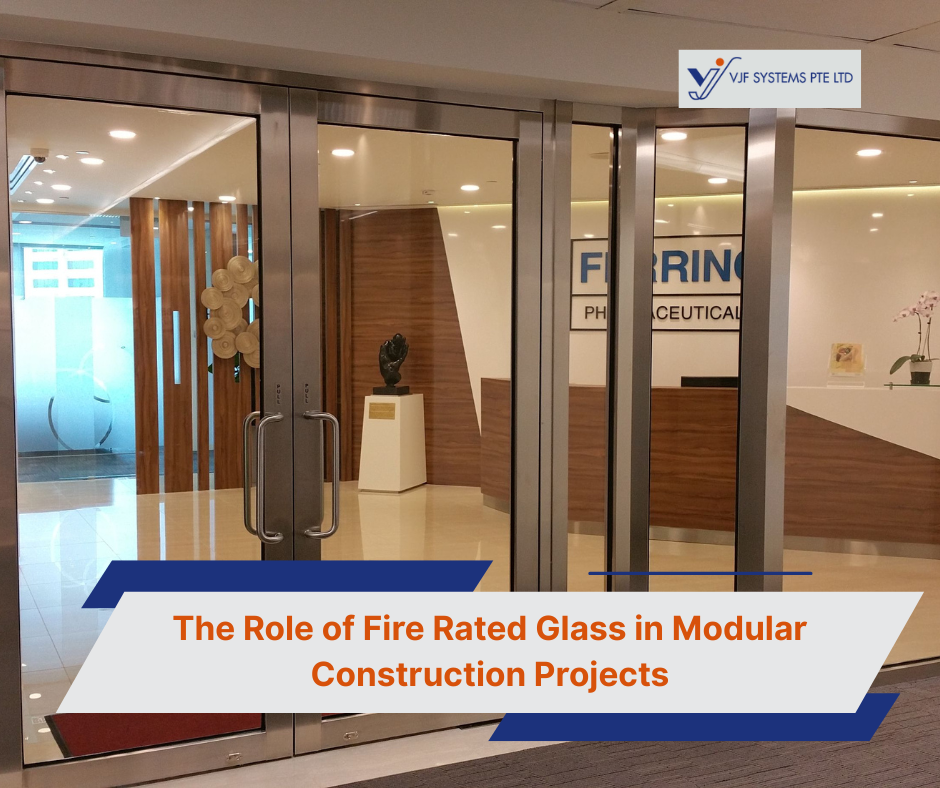
Why modular construction need fire safety and its core
Modular construction is known for its ability to deliver faster, cleaner and more sustainable results compared to traditional building methods. Since the majority of components are prefabricated off-site and assembled quickly on location, the approach significantly reduces project timelines. However, safety standards do not take shortcuts and fire safety is one of the most heavily regulated aspects of construction.
In this context, fire rated glass in modular construction projects becomes indispensable. Modular designs are often compact, with interconnected spaces. This means that the choice of fire-resistant materials can literally define the safety of the structure. Glass, which is typically seen as fragile, becomes a strong defender when engineered to resist flames, smoke and heat for extended periods.
A well-designed fire protection strategy in modular spaces ensures that even in high-density layouts, people have time to exit safely and that damage to property is minimised. Fire rated glass is a major contributor to this strategy.
Balancing aesthetics with safety
One of the biggest misconceptions about fire rated glass is that it is purely functional. In reality, it allows architects and builders to design spaces that feel open, transparent and connected while still adhering to rigorous fire safety codes.
In modular construction, where flexibility and adaptability are key, fire rated glass bridges the gap between safety and design freedom. Large panels can divide spaces without making them feel closed-off, while still maintaining the protective barrier needed in the event of a fire.
This balance is critical in settings where modular projects are used whether for workplaces, residential developments or public buildings. People want spaces that are not only safe but also bright, comfortable and modern. Fire rated glass delivers on both fronts, ensuring safety doesn’t come at the cost of design.
Ensuring compliance with building codes
Every modular construction project must meet strict local and international fire safety regulations. Fire rated glass provides a straightforward way to achieve compliance without compromising on other design or functional goals.
The material is tested under controlled conditions to prove its ability to contain flames and heat for a specified duration often measured in minutes. By incorporating this type of glazing into walls, doors or partitions, modular buildings can pass inspections with confidence.
More importantly, compliance is not just there for the sake of requirement. It ensures that occupants have enough time to evacuate safely in case of a fire. That peace of mind is invaluable, especially in environments where people expect safety to be built into the design from the start.
For developers, the use of fire rated glass also streamlines approval processes. Inspectors are more likely to clear projects that demonstrate thoughtful integration of fire safety features. This saves time and reduces the risk of costly delays.
The role of fire rated glass in modular efficiency
Efficiency is the hallmark of modular construction. Each component must fit together seamlessly, and every material chosen must support this speed of assembly. Fire rated glass is no exception.
Because it can be manufactured in precise dimensions and installed within prefabricated frames, it integrates neatly into modular construction systems. This compatibility reduces delays and ensures that fire safety features are not an afterthought but a built-in part of the project.
In addition, its durability ensures long-term performance, minimising the need for replacements or repairs. That reliability is especially important in modular settings, where the promise of efficiency extends beyond construction and into the building’s lifecycle.
Design flexibility in modular spaces
Another key advantage of using fire rated glass in modular construction projects is the design flexibility it offers. Modular buildings are designed to evolve—walls can be added, removed, or rearranged depending on future needs. Fire rated glass complements this adaptability by providing a versatile option that can be used across various applications, from partitions to facades.
Since modular construction is often used in urban settings where space is limited, fire rated glass also enhances natural light flow. This not only reduces reliance on artificial lighting but also creates brighter, healthier indoor environments without sacrificing safety.
Design flexibility also extends to customisation. Fire rated glass can be produced in different finishes, sizes, and fire-resistance ratings. This means modular projects can maintain their unique aesthetic goals while still protecting occupants.
Sustainability and energy efficiency
Sustainability is another factor driving the popularity of modular construction. Prefabrication reduces waste, lowers carbon emissions and often uses eco-friendly materials. Fire rated glass contributes to these goals as well.
Modern variants are designed not only for fire resistance but also for thermal efficiency. They can help regulate indoor temperatures, improve insulation and support energy savings over time. In modular construction where sustainability is a top priority, these added benefits make fire rated glass an even more valuable choice.
Additionally, the longevity of fire rated glass contributes to sustainability. Fewer replacements mean fewer resources used and this long-term performance supports the environmental promise of modular projects.
Future-proofing modular projects
As construction trends evolve, modular buildings are likely to become even more sophisticated. Integrating materials like fire rated glass ensures that these projects remain ahead of the curve in terms of both safety and design.
While choosing fire rated glass is part of meeting today’s regulations, it can also be an act of anticipating future needs. With increasing attention on safety, sustainability and adaptability, this material ensures that modular projects are built to stand the test of time.
For developers and architects, this means greater confidence that their projects will remain compliant even as codes and expectations change. For occupants, it means a safer, more comfortable, and more sustainable environment.
Building with confidence
Ultimately, the role of fire rated glass in modular construction projects comes down to one word: confidence. Builders can be confident that they are meeting regulations. Designers can be confident that they are not sacrificing aesthetics. Occupants can be confident that their safety has been prioritised.
By striking a balance between form and function, fire rated glass proves that safety and style can coexist in modular construction. As the demand for faster, safer and greener buildings continues to grow, this material is set to remain a key part of the future of construction.